|

| |

Range: Indo pacific Islands
Habitat: Dense Tropical Forests,
to coastal plains. Habitat varies widely by island. This
species is known to venture into salt water estuaries to hunt for mollusks and
fish.
Natural Diet: Carnivore, very
opportunistic feeders. Will also eat carrion.
Diet at Rain Forest: Rodents,
chicken. Diet is supplemented with various vitamins.
Size: 5-8 feet in length, may
weigh as much as 80 pounds.
RainForest Facts:
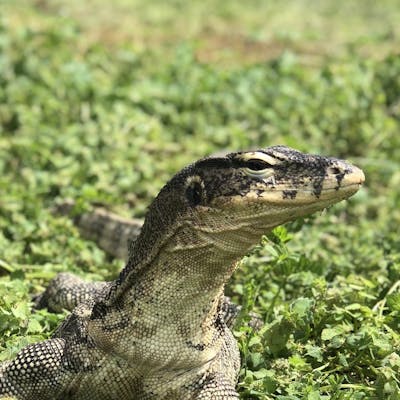
The second largest living lizard species on earth. The Water Monitor is
the second heaviest monitor on our planet. The Crocodile monitor actually
grows longer than both the Komodo Dragon as well as the Malayan, or Asian Water
Monitor but does not attain the body weight of these lizards. The water monitor
closely resembles the Komodo Dragon.
The Water Monitor's main
hunting technique is to run after prey that it has spotted, rather than stalking
and ambushing. Like snakes, they have a forked tongue that they stick in and out
regularly to "smell" for potential prey.
|
The name "monitor" probably originated from the superstitious belief
that Nile monitors warned of the presence of crocodiles. Nile monitors
eat crocodile eggs and were therefore often seen near crocodile
nesting sites.
|
Water Monitors are rarely found far from
water. Both fresh and saltwater. They are particularly common in
mangroves, banks of large rivers. Also found in grasslands, forests,
swamps, beaches and even cultivated land. From sea level up to 1,100m
high. They are among the first large vertebrates to colonize new
islands. |
Water Monitor Lizards are highly mobile. They swim well (keeping their limbs to
the side of the body, and propelling themselves through sinuous undulations of
the flattened tail). They have even been seen swimming far out at sea. They can
remain underwater for up to half an hour. They run fast for their size as they
have powerful leg muscles. In fact, they are faster than most of us can run.
They also climb well, to search for
food
as well as to escape predators, using their strong curved claws. The young
usually stay in trees for safety. If cornered up a tree, they will jump into
the safety of a stream or river.
They usually hide in a burrow built in a river bank. The entrance starts on
a downward slope but then increases forming a shallow pool of water. The
average length of the burrow is about 9.5 m, the average depth is about 2m.
In the burrow, the average temperature is around 26 degrees Celsius.
Breeding:
Water Monitor lizards breed
relatively young compared to other species of monitor lizards. Larger females produce a larger clutch than smaller,
younger females. Up to 40
eggs a year in 2 or more clutches are relatively common. Mating
of both captive and wild animals generally involves a lot of biting and
scratching. Females lay their eggs 4 to 6 weeks after breeding. 3 to 25
white, soft-shelled eggs are laid, with an average of 15 per clutch. Eggs
are laid in termite mounds (both active or abandoned mounds), along rotting
logs or hollow stumps or in burrows. Eggs take 2.5-10 months or more to
incubate.
Juveniles are more brightly colored with bright yellow markings on the body
and yellow bands on the tail contrasting against a darker body. But they are
more secretive and less commonly seen. Males grow faster than females,
become longer and heavier. In ideal conditions, they reach maturity in 2
years at 1-1.3m for males and 0.5-1.2m for females. Water Monitors can live
for up to 15 years.
Role in the habitat: As is often the
case with large predators their roll in the environment is actually fairly
complicated. Large monitors such as the water monitor act as both scavengers
and aggressive predators. By scavenging (eating
carrion) Water Monitors
help keep the overall habitat free from potentially problem causing rotting
animal flesh. As aggressive predators they help keep rodent and other
vermin populations under control. They in turn provide food for larger carnivores such as
crocodiles and birds of prey. Small young Water Monitors are particularly
vulnerable even to large birds such as herons.
| When attacked, Water
Monitors try to intimidate predators by lashing out with their tails,
inflating their throats, hissing loudly, turning sideways and
compressing their bodies. When cornered, they will bite and claw. Unlike
other lizards, they do not drop their tails in self defense.
|
Water Monitors are a source of protein
and income to poor rural people. Sustainable harvesting is possible because
even in places where they are hunted, they are still rather common.
Status and threats:
Water Monitors are not considered endangered although they are
commonly hunted for their meat and skin and have been exterminated over most
of mainland India. Elsewhere, populations have declined sharply. Habitat
destruction also affects them. Up to 1.5 million skins are legally exported
each year mainly from Indonesia to Europe, Japan
and
the US to be made into fashion goods. One explanation why they remain
plentiful despite this is because the skins of medium-sized Monitors are
preferred. Those of larger Monitors are too thick and tough, thus possibly
sparing large females who lay more eggs. Their meat is considered delicious
and a bewildering array of potions are made from various parts of their
bodies, ranging from cures for diabetes to aphrodisiacs and deadly poisons
used in assassinations. The gall bladder is brewed for a medicinal tea to
treat heart and liver problems. Skin ointments are made from the rendered
fat. In Sri Lanka, the locals protect them because they eat the crabs that
would otherwise undermine the banks of the rice fields.
|
|