|
|
|
|
RainForest Adventures is home to an amazing array of lizards. From the
tiny gecko to the giant Water Monitor we have assembled a
Most of our lizards our fed daily. If you would like to see the feeding please come early, the Iguanas and other herbivores are fed early each morning. Feeding time is approximately 11:30 a.m. daily. The stars of the show at Rain Forest are the critically endangered Rhinoceros iguanas! These lizards have been donated to RainForest after being confiscated in a smuggling operation gone bad! An Introduction to the biology of Lizards
The Lizards An Introduction
The Snakes and the lizards belong to a large reptilian family called Squamata. This family is sub-divided into the Snakes (Serpentes) and the Lizards (Sauria). There are currently over 3000 species of lizards recognized by scientists. As is the case with virtually all living species new animals are periodically discovered as recently shown with the discoveries in Irian Jaya announced in January of 2006. Additionally the advent of new technologies allows us to research animals at the genetic level further complicating and expanding the debate over species and sub-species. But for the sake of this article we are going to be using widely accepted information available today.
Lizards are found throughout much of the earth’s surface, with the obvious exception of the Polar Regions. The vast majority of species occurring in the warm tropical climates found near the equator. Temperate species of lizards can be found as far north as Canada, but both the number of species and concentrations of animals declines the further north one travels. One interesting anatomical feature of many of the lizards is breaking plates, or planes found in the tail. This interesting adaptation allows the lizard to quite literally break the tail cleanly along a vertical cleave and in many cases regenerate the missing tail region. The obvious benefit is the animals ability to escape a predator by allowing the predator to continue to grasp the tail while the lizard scampers away to live another day. Interestingly the coloration and scale pattern of the regenerated portion of the tail does not match the original tail, leaving the lizard with a mismatched tail! It is important to note that many species of lizards use their tail as a fat and food store, much like we use a refrigerator, once the tail is lost the lizard losses some of it’s ability to store food for the lean times, the regeneration process is not just to replace the tail for future use as an escape device, it is quite literally a matter of life and death for the lizard to regenerate the tail. The actual process of regenerating a tail may actually be costly to the owner as well; the energy an nutrition needed to replace the tail may take a toll on desert species etc. where food and water are scarce to begin with.
Reproduction in lizards varies greatly; most are egg layers while a smaller percentage gives birth to live off-spring. Some species lay a small number of eggs or live babies, while others such as the Veiled or Yemen Chameleon can produce as many as 80 viable eggs per clutch several times per year.
Parthenogenesis or “Virgin Birth” is extremely rare among vertebrates. In fact outside of a few fish, amphibians and a tiny number of lizards this amazing process is only seen among the lowest forms of life on earth. All female populations laying fertile eggs has long been studied and is the subject of much debate. The Whiptail lizard is one of the only lizards known to be capable of reproducing without males of the species present. The obvious advantages of being parthenogenetic include being able to colonize remote areas where a single animal can start a colony. A serious disadvantage is the lack of genetic diversity. Climate or other environmental changes would put a parthenogenetic animal at great risk of being unable to adapt to the rapid onset of changes. A new disease or parasite could easily wipe out a vulnerable population of parthenogenetic creatures, whereas a healthy diverse population of other creatures may be able to adapt to such changes.
Madagascar
Day Gecko Range: Madagascar Habitat: Dense Tropical Forests Natural Diet: Small insects, nectar Diet at Rain Forest: Small insects, baby food Size: 4-6" RainForest Facts: One of the most brightly colored of all gecko species this is the animal used by Geico in their commercials. Females deposit one or two hard shelled eggs which take approximately 85-90 days to hatch. Dense Rain Forests are the home of this wonderful little gecko. Status in Wild: Numbers are rapidly declining due to over collection as well as loss of habitat. Standingi
Day Gecko Range: Madagascar Habitat: Arid regions Natural Diet: Small insects Diet at Rain Forest: Small insects Size: 5-6" RainForest Notes: Brightly colored as babies, the Standingi Day gecko will turn a pale shade of green as an adult. Females deposit 2-3 eggs per clutch and are capable of multiple clutches per breeding season. Status in Wild: Numbers are rapidly declining due to loss of habitat Leopard
Gecko Range: Africa Habitat: Arid regions Natural Diet: Small insects Diet at Rain Forest: Small insects Size: 3-6 inches in total length RainForest Facts: Leopard geckos in captivity can become quite tame and actually seem to seek out attention by humans. Females deposit one or two soft leathery eggs, the eggs require approximately 80 days to hatch. Many unusual color variations of the leopard gecko are now being produced by breeders in captivity. Status in Wild: Numbers are rapidly declining in the wild. Leaf Tail
Gecko Range: Malaysia Habitat: Dense Tropical Forests Natural Diet: Small insects Diet at Rain Forest: Small insects Size: 5-8 inches RainForest Facts: One of the most cryptically colored of all geckos the Leaf tail does an incredible job of hiding in both the wild as well as the exhibits at RainForest. Status in Wild: Numbers are rapidly declining due to over collection as well as loss of habitat. Tokay
Gecko Range: Asia Habitat: Dense Tropical Forests Natural Diet: Small insects Diet at Rain Forest: Small insects Size: 5-10 inches RainForest Facts: An extremely vocal lizard, the Tokay gecko derives it's common name for the geckos ability to make a very loud noise that sounds like "to-kay" Rain Forests of Asia contain many natural predators of the Tokay Gecko, for this reason the Tokay has developed a nasty disposition as well as a powerful bite. In Florida the Tokay Gecko is often used in Greenhouses as a natural form of pest control, cockroaches and other insects do not stand a chance with this formidable hunter prowling around at night. Status in Wild: Numbers appear to be stable in the majority of the undisturbed regions of the Tokay Geckos natural range. White Line
Gecko
Range: Indonesia Habitat: Dense Tropical Forests Natural Diet: Small insects Diet at Rain Forest: Small insects Size: 5-8 inches in total length RainForest Facts: Named for the conspicuous line running dorsally down the entire length of the geckos body, the White line gecko has extremely well developed feet pads that allow excellent adhesion to vertical surfaces. Status in Wild: Numbers are rapidly declining due to over collection as well as loss of habitat. Crested
Gecko Range: Indonesia Habitat: Dense Tropical Forests Natural Diet: Small insects Diet at Rain Forest: Small insects Size: 6-8 inches RainForest Facts: Named for the prominent crest that begins over each eye, the Crested gecko is strictly arboreal in nature. Status in Wild: Numbers are rapidly declining due to over collection for pet trade as well as loss of habitat.
Frilled
Dragon Range: Australia Habitat: Semi-desert dweller Natural Diet: Small insects, fresh greens Diet at Rain Forest: Small insects, fresh fruits and greens Size: Males are somewhat larger than females and tend to be more brightly colored RainForest Facts: An amazing lizard, the Frilled Dragon is actually the animal used by the creators of Jurassic Park to model some of the dinosaurs. The female Frilled Dragon is capable of producing multiple clutches of soft leathery eggs during a breeding season. Up to 10 leathery frilled dragon eggs are deposited at a time, the clutch of eggs usually requires about 80 days to hatch. Status in Wild: Numbers stable in most of the Frilled Dragons range
Bearded
Dragon Range: Australia Habitat: Desert dweller Natural Diet: Small insects, fresh greens, juveniles tend to be more carnivorous than adults. Diet at Rain Forest: Small insects, fresh fruits and greens. Size: Males are somewhat larger than females and tend to be more brightly colored RainForest Facts: Truly one of Australia's wonders, the Bearded Dragon is a fascinating creature to study. The social interaction between bearded dragons rivals that of many mammals. Female bearded dragons are capable of producing several clutches of eggs per breeding season, each bearded dragon clutch may contain up to 15 eggs. The movie Holes featured the bearded dragon as the bad guy! Unlike the Hollywood creatures the real bearded dragons are not venomous. Status in Wild: Numbers stable in most of the bearded dragons natural range. Captive breeding of this species is reaching amazing numbers. The bearded dragon is being bred in many new and unusual color patterns to supply the pet market with this easy to care for, reasonably long lived lizard. Water
Dragon Range: Asia Habitat: Dense Tropical Forests Natural Diet: Insects, small vertebrate including fish and small mammals Diet at Rain Forest: Insects, small mice Size: 16-18 inches Keeper Notes: A highly aquatic lizard the Water Dragon spends several hours per day either submerged or partially submerged in standing water. Females lay eggs in the late spring or early summer of the year. A typical clutch will contain 8-12 leathery eggs deposited in soft soil or leaf litter near a permanent source of water. Status in Wild: Numbers are rapidly declining due to over collection for pet trade as well as the introduction of feral animals such as domestic cats. Uromastyx Range: Africa Habitat: Desert Dweller Natural Diet: Small insects Diet at Rain Forest: Small insects Size: 5-9 inches in total length RainForest Facts: Highly variable by species the Uromastyx if often maintained as a pet lizard Status in Wild: Numbers are rapidly declining due to over collection for skin trade as well as loss of habitat. High Resolution Pictures Available Plated
Lizard Range: Sub-Saharan Africa Habitat: Desert dweller Natural Diet: Small insects, occasional mice Diet at Rain Forest: Small insects, small rodents Size: 12-14 inches in total length Keeper Notes: This lizard is capable of surviving extreme temperature fluctuations. Daytime temperatures in the desert of it's home often exceed 110 degrees Fahrenheit. Status in Wild: Unknown High Resolution Pictures Available Blue
Tongue Skink
Range: Australia Habitat: Dense Tropical Forests Natural Diet: Omnivorous Diet at Rain Forest: Small insects, fresh fruits and vegetables Size: 10-14 inches in total length RainForest Facts: As the name indicates this skink possess a bright blue tongue that is used to warn off potential predators. The female Blue Tongue skink gives birth to live babies. Status in Wild: Numbers are stable in most parts of the lizards natural range Monkey
Tail Skink Range: Solomon Islands Habitat: Dense Tropical Forests Natural Diet: Small insects Diet at Rain Forest: Small insects Size: Males and females are virtually indistinguishable from each other, each is about 18-20 inches in total length, the Solomon Island skink is the largest of all living skinks. RainForest Facts: A fascinating lizard that gives birth to live babies, the normal birth is one youngster, on occasion a second is born. The prehensile-tail skink faces serious pressures from loss of habitat in it's natural range. During World War II the animals natural range was the site of extremely serious fighting between the Japanese and the Allies, much loss of habitat occurred during the early 1940's Status in Wild: Numbers are rapidly declining due to loss of habitat. Not thought to be threatened at this time. Legless
Lizard Range: Europe and parts of Russia Habitat: Temperate forests Natural Diet: Small insects, occasional mice Diet at Rain Forest: Small insects, crickets Size: RainForest Facts: Looking remarkably like a snake, the legless lizard has unique features that help the trained eye distinguish it from the snake. All legless lizards posses ear openings, snakes have none. The tongue of the lizard is not long and forked like a snake. Legless lizards can close their eyes, snakes do not posses eyelids. The United States has it's own versions of legless lizards, most occurring in the eastern United States, the legless lizards in the U.S. are often called glass lizards due to their ability to seemingly break like glass. The actual fact is the lizard is dropping it's tail to escape a predator. Status in Wild: Numbers are rapidly declining due to over collection as well as loss of habitat. Crocodile
Monitor Range: Indonesia, Paupau New Guinea Habitat: Dense Tropical Forests Natural Diet: Mammals, Birds Diet at Rain Forest: Primarily rodents Size: Females up to 10 feet, males up to 12 feet (including tail) RainForest Facts: A highly arboreal lizard, the Crocodile Monitor is actually considered the longest of all living monitor lizards, the tail can be as much as 45% of the length of the total animal. Noted for having a highly aggressive personality, the Crocodile Monitor is given plenty of respect by the keepers at RainForest Adventures. Female Crocodile Monitors deposit 8-10 leathery eggs in carefully excavated nests of organic material. The decomposition of the organic matter assists in maintaining adequate incubation temperature. Status in Wild: Numbers are rapidly declining due to over collection for skin trade as well as loss of habitat. Green Tree
Monitor Range: Indonesia Habitat: Dense Tropical Forests Natural Diet: Small insects Diet at Rain Forest: Small insects Size: 18-22 inches RainForest Facts: This beautiful lizard is emerald green allowing the Monitor to blend into it's surroundings. Status in Wild: Numbers are rapidly declining due to over collection for skin trade as well as loss of habitat.
Black Tree
Monitor Range: Aru Island, Indonesia Habitat: Dense Tropical Forests Natural Diet: Small insects Diet at Rain Forest: Small insects Size: 18-26 inches RainForest Facts: The Black tree monitor is rapidly disappearing in the wild, their numbers may never have been high as this monitor lizard lives in a very limited geographical range. Like all Monitor lizards the Black Tree Monitor lays eggs, in this case the female deposits 2-4 elongated leathery eggs after approximately 70 days of mating. The Black Tree Monitors eggs require approximately 80 days to hatch. Status in Wild: Numbers are rapidly declining due to over collection for skin trade as well as loss of habitat. Mangrove
Monitor Range: Pacific Islands extending from Japan to near Australia, one of the most widely distributed of all monitor lizards. Habitat: Dense Tropical Forests, to coastal plains. Habitat varies widely by island. Natural Diet: Carnivore, very opportunistic feeders Diet at Rain Forest: Rodents Size: 3-4 feet in length RainForest Facts: A highly variable lizard in coloration the Mangrove monitor is a medium sized lizard that produces a clutch of eggs that average 8-10. Status in Wild: Numbers are rapidly declining due to over collection for skin trade as well as loss of habitat. Some native populations of people still consume this lizard as part of a native diet. Malayan
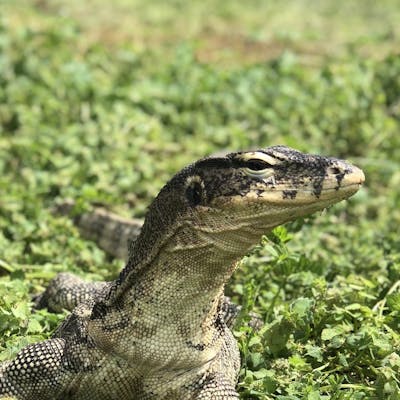
Water Monitor Range: Indo pacific Islands Habitat: Dense Tropical Forests, to coastal plains. Habitat varies widely by island. Natural Diet: Carnivore, very opportunistic feeders Diet at Rain Forest: Rodents Size: 5-8 feet in length, may weigh as much as 80 pounds. RainForest Facts: The second largest living lizard species on earth. The water monitor closely resembles the Komodo Dragon. The lizard shown in this photo is Hadji, a 10 year old male Malayan Water Monitor. Status in Wild: Numbers are rapidly declining due to over collection for skin trade as well as loss of habitat. Some native populations of people still consume this lizard as part of a native diet.
Green
Iguana Range: Central and South America Habitat: Dense Tropical Forests Natural Diet: herbivores Diet at Rain Forest: Fresh fruits and vegetables Size: Males up to 6' in length, females considerably smaller RainForest Facts: One of the most frequently kept of all pet lizards. The Green Iguana is now farmed in El Salvador to provide millions to the pet trade in the United States as well as other nations. Female Green Iguanas produce approximately 12-18 eggs per clutch and are capable of producing more than one clutch of eggs per year. The primary reason for such a high rate of reproduction is natural predation by many animals. The Green Iguana winds up on the dinner menu for everything from predatory birds, to Boa Constrictors and even Man! Status in Wild: Varies greatly by region, the Green Iguana has been introduced into South Florida as well as several Caribbean islands that the Iguana had not previously inhabited. Rhino
Iguana Range: Islands of the Caribbean Habitat: Arid desert dwellers to lush forest Natural Diet: Omnivores, Diet at Rain Forest: Primarily fresh greens supplemented with fruit and protein source Size: Varies by species RainForest Facts: These iguanas are some of the most seriously threatened reptiles on earth. Loss of habitat along with the introduction of cats and other feral animals to their island homes has led to a serious decline in numbers Status in Wild: Threatened or endangered depending on species
RainForest Adventures, Smoky Mountains, Tennessee |
|
|